
- Insights
- 11 Min Read
- Cordatus Resource Group

In This Blog
The Problem
Most organizations are selecting low-code platforms based on demo polish and feature checklists rather than architectural fit, integration depth, and long-term total cost of ownership. The result is vendor lock-in, mounting technical debt, and automation programs that stall before reaching enterprise scale.
Our Thesis
The biggest risk in your automation strategy is not choosing the wrong technology. It is choosing the right technology for the wrong operating model. Platform selection is an architecture decision, not a procurement decision, and organizations that treat it otherwise spend 2x to 3x more on remediation than they would have on proper upfront evaluation.
Business Impact
The low-code platform market is projected to exceed $49 billion in 2026, with 75% of new enterprise applications expected to be built on low-code technologies (Gartner). Yet 83% of enterprise data migration projects fail or overrun their budgets, and 43% of organizations cite complex implementation and maintenance as their top low-code challenge (KPMG). Platform selection is the single highest-leverage decision in any automation program.
Introduction: The $49 Billion Bet Most Organizations Are Making Blind
Low-code platforms have crossed the threshold from departmental experiment to enterprise infrastructure. Gartner projects that 75% of all new enterprise applications will be built using low-code technologies by 2026, up from less than 25% in 2020. The global market is expected to surpass $49 billion this year. Every major systems integrator, every Big Four advisory practice, and every enterprise software vendor has a low-code story to tell.
None of that changes the fact that most organizations are making their platform selection decisions badly.
The pattern is consistent across industries. A business unit identifies an automation opportunity. IT evaluates two or three platforms based on feature checklists and vendor demos. Procurement negotiates licensing terms. A pilot launches, delivers quick wins, and the organization commits. Eighteen months later, the platform cannot scale beyond departmental workflows, integration with core systems requires custom middleware that was never budgeted, and the cost of migrating to a better-fit solution rivals the original implementation spend.
This is not a technology failure. It is an evaluation failure. And it is happening at a pace that matches the market’s growth: 62% of IT decision-makers now express concern about vendor lock-in with their digital platforms (BCG), and 70% of organizations already committed to a platform are actively scanning the market for alternatives. That is not buyer satisfaction. That is buyer remorse at scale.
This insight explains why platform selection is the highest-leverage decision in any automation strategy, where the evaluation process consistently breaks down, and provides a step-by-step methodology for getting it right the first time.
Why Does Platform Selection Matter More in 2026 Than Ever Before?
Three converging forces have turned what was once a departmental tool choice into a strategic architecture decision with multi-year consequences for cost structure, operational agility, and competitive positioning.
The first force is scale of commitment. Gartner predicts that 75% of large enterprises will use at least four low-code tools by 2026. That multi-platform reality means each selection compounds across the technology estate. A poor choice in one business unit creates integration friction, governance gaps, and redundant licensing costs that ripple across the organization.
The second force is AI convergence. Every major low-code vendor is embedding generative AI and agentic capabilities into their platforms. Gartner’s 2025 Magic Quadrant notes that AI-native capabilities are now a key selection factor. But the maturity of these AI features varies enormously across vendors. Organizations that select a platform based on today’s feature set without evaluating the vendor’s AI roadmap risk being locked into a platform that cannot support the workflows they will need in 18 to 24 months.
The third force is regulatory pressure. The EU AI Act reaches full enforcement in August 2026, requiring human oversight, risk assessments, and activity logging for high-risk AI applications. Multiple U.S. states, including Colorado and California, have enacted or are enforcing AI governance and transparency laws in 2026. Any low-code platform that deploys AI-assisted automation in regulated domains must support compliance logging, audit trails, and governance controls. Platforms that do not will either limit your use cases or expose your organization to regulatory risk.
Where Does the Low-Code Platform Evaluation Process Break Down?
Most evaluation failures are not caused by selecting a bad platform. They are caused by evaluating the right platforms against the wrong criteria, at the wrong level of the organization, with the wrong time horizon.
Here are the five most common failure modes:
1. Demo-Driven Selection
Low-code demos are designed to impress. A skilled vendor representative can build a functional application in 30 minutes that would take a traditional development team weeks. The problem is that demos showcase ideal conditions: clean data, simple integrations, and a single user role. They do not reveal how the platform behaves under production load, with messy enterprise data, across complex role-based access control requirements, or when connecting to legacy ERP and CRM systems that were never designed for API-first integration.
2. Feature Checklist Evaluation
Procurement teams often reduce platform evaluation to a spreadsheet: does platform A have feature X? This approach treats all features as equal and misses the distinction between a feature that exists and a feature that works well at enterprise scale. A platform may check the box for “API integration” while requiring weeks of custom development to connect to your specific SAP or Oracle instance. The checklist says yes. The implementation timeline says otherwise.
3. Ignoring Total Cost of Ownership
Licensing fees represent a fraction of the true cost. According to industry benchmarks, integration engineering, ongoing monitoring, and model refresh cycles typically add 40% to 70% on top of the sticker price of any platform. Prompt engineering and workflow design alone require specialized operators commanding $150,000 to $250,000 in annual compensation. Data preparation and cleaning consumes 60% to 80% of total AI project time (Gartner). None of these costs appear in the vendor’s pricing proposal.
4. Departmental Selection for Enterprise Needs
A business unit selects a platform that solves its immediate workflow automation needs. Six months later, three other departments want to use the same platform, but it lacks the governance, security, and multi-tenant capabilities required for enterprise-wide deployment. The organization now faces a choice: force-fit a departmental tool into an enterprise role, or migrate to a different platform at significant cost. According to research, 83% of enterprise data migration projects fail or exceed their budgets.
5. No Exit Strategy
Vendor lock-in is architectural, not contractual. When a platform uses proprietary domain-specific languages, closed runtime engines, and non-exportable data formats, every application built on it becomes a hostage. The more successful your low-code initiatives become, the more locked in you are. Growth becomes a liability rather than an asset. Yet most organizations conduct zero exit planning during the selection phase.
How Should Organizations Evaluate Low-Code Platforms for Enterprise Automation?
Start with your operating model, not the vendor landscape. The most common and most costly mistake is evaluating platforms before defining what you need them to do, for whom, under what governance structure, and at what scale.
The following six-step methodology is designed to be completed in 8 to 10 weeks and produces a decision-grade evaluation that accounts for architectural fit, total cost of ownership, governance requirements, and exit risk.
Step 1: Automation Inventory and Classification (Weeks 1 to 2)
Catalog every automation candidate across the organization. For each, document: the process owner, input/output data types, integration dependencies, current error rate, regulatory sensitivity, and volume (transactions per month). Classify each candidate using a two-axis matrix: process complexity (simple rules-based to judgment-intensive) and organizational scope (single team to cross-functional).
Step 2: Architecture Requirements Definition (Week 3)
Based on the inventory, define non-negotiable architecture requirements. These typically include: integration patterns (REST APIs, webhooks, event-driven), data residency and sovereignty constraints, authentication and access control models (SSO, RBAC, ABAC), audit and compliance logging, scalability thresholds, and deployment model (cloud, on-premises, hybrid). This step eliminates 30% to 50% of the vendor landscape before a single demo is scheduled.
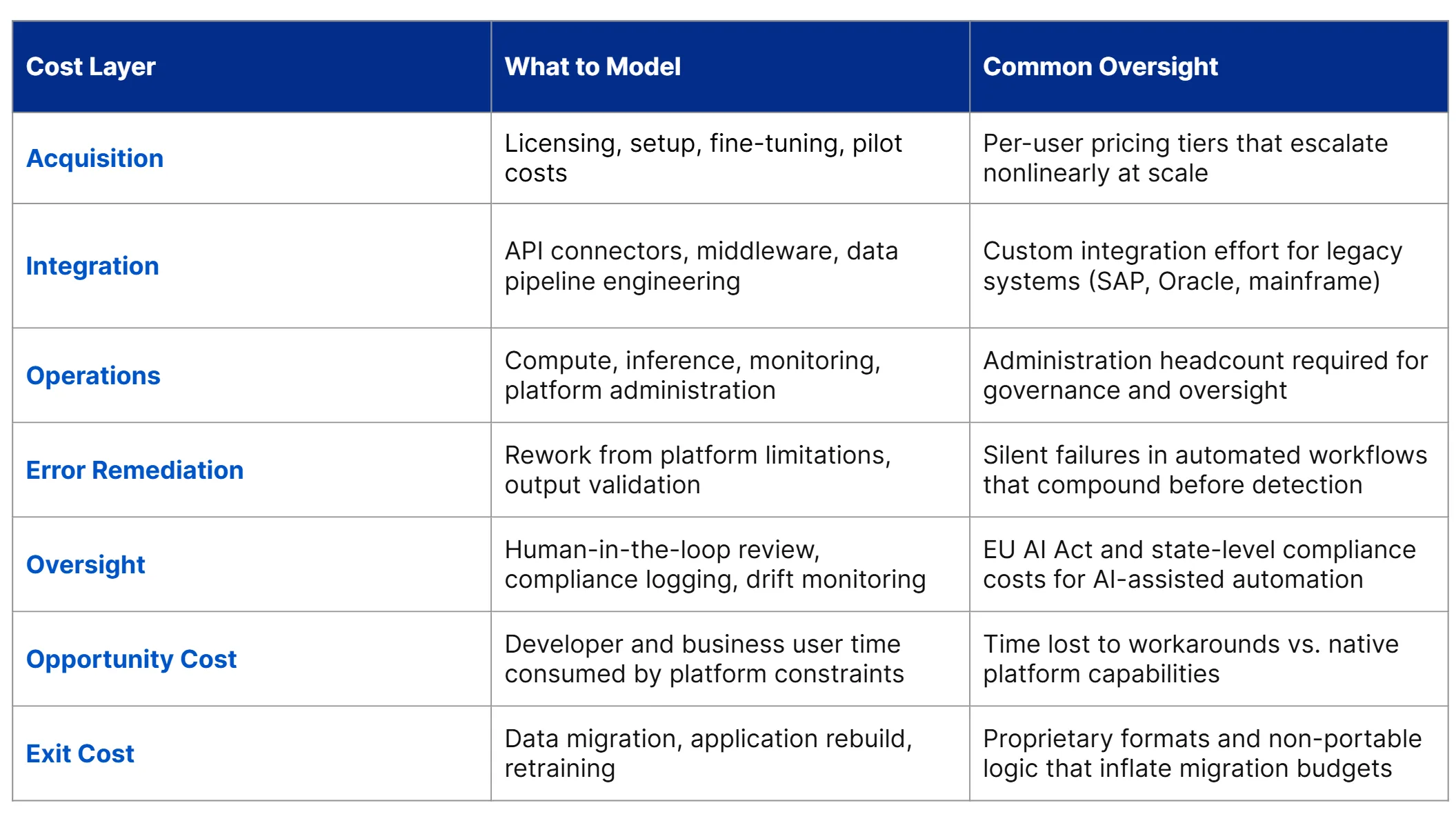
Step 3: Total Cost of Ownership Modeling (Weeks 4 to 5)
Build a five-year TCO model for each shortlisted platform across seven cost layers:
Step 4: Proof of Concept on Real Workflows (Weeks 5 to 7)
Run a structured proof of concept (PoC) using actual production data and real integration endpoints. Do not accept sandbox environments with synthetic data. The PoC should test: a Quadrant 1 workflow (high predictability, low failure severity) for speed and ease of build; a Quadrant 2 workflow (high predictability, high failure severity) for governance controls, audit logging, and human review integration; and at least one cross-system integration to evaluate connector maturity and API reliability. Measure: time to build, time to integrate, error rate in production-equivalent conditions, and administrative overhead to maintain.
Step 5: Governance and Scalability Assessment (Week 8)
Evaluate each platform against your governance requirements: role-based access controls, application lifecycle management, version control, audit trails, compliance certifications (SOC 2, HIPAA, ISO 27001), and citizen developer guardrails. Test scalability by simulating projected Year 3 transaction volumes. A platform that performs well at pilot scale but degrades at enterprise volume is a time bomb with a delayed fuse.
Step 6: Exit Risk and Portability Analysis (Weeks 9 to 10)
For each finalist, answer: Can we export application logic in standard, reusable formats (React, standard JavaScript, open APIs)? Does the platform use open standards (WebAssembly, REST, OAuth) or proprietary runtime engines? What is the estimated cost and timeline to migrate 100 applications to an alternative platform? What happens to our data and applications if the vendor is acquired, changes pricing, or discontinues the product?
Document these answers in a formal exit risk assessment. Any platform that scores poorly on portability should require explicit C-suite sign-off before commitment.
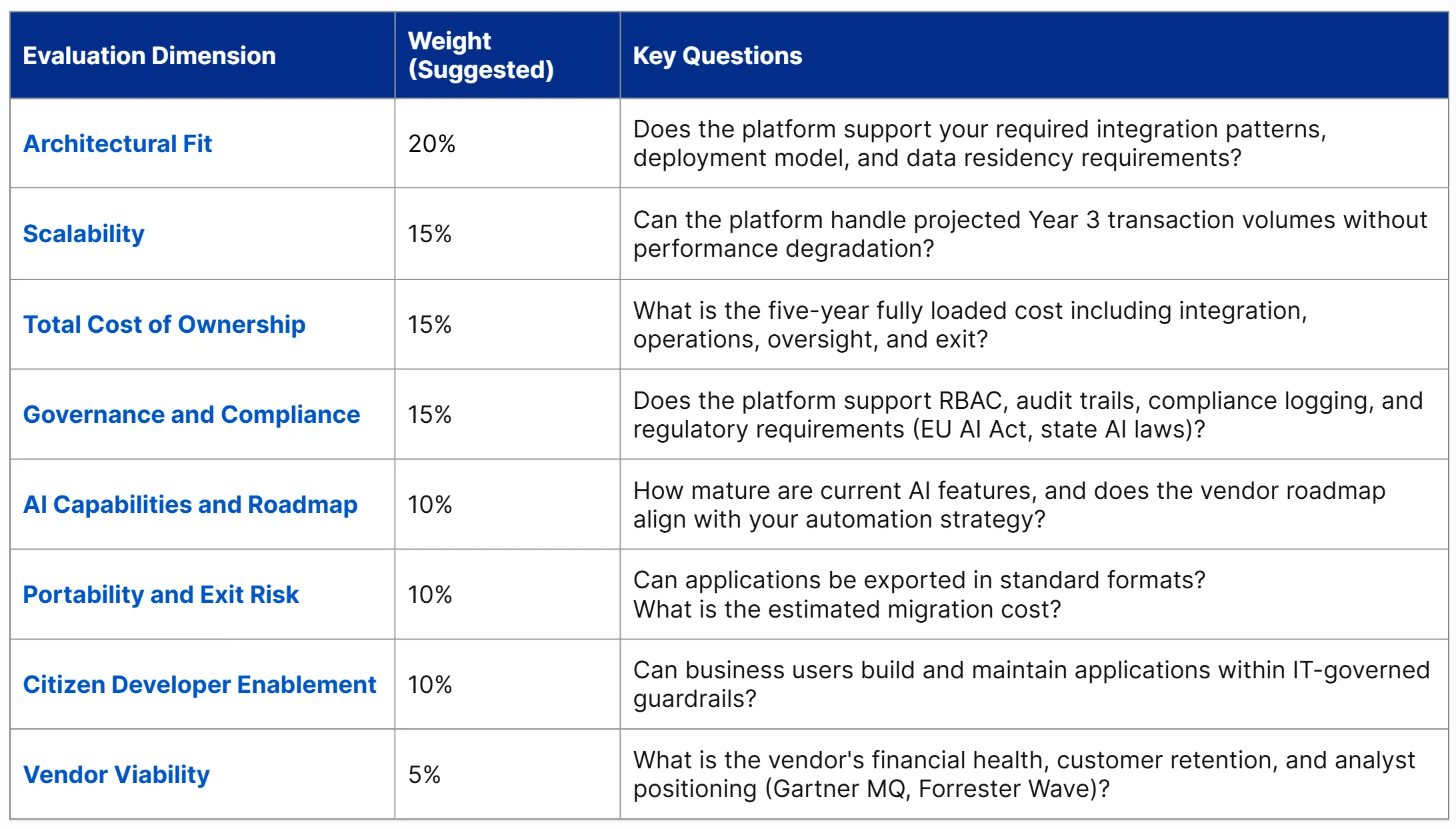
What Does the Platform Selection Decision Matrix Look Like?
Use this matrix to score each shortlisted platform across the eight dimensions that determine whether a low-code investment scales or stalls. Weight each dimension based on your organizational priorities.
Score each dimension on a 1 to 5 scale. Multiply by weight. Sum for a composite score. Any dimension scoring below 3 should be treated as a disqualifier regardless of composite score.
What Are the Hidden Costs of Getting Platform Selection Wrong?
The financial impact of a misaligned platform selection extends far beyond licensing fees. It compounds through integration rework, technical debt accumulation, governance gaps, talent attrition, and the opportunity cost of automation programs that stall at pilot stage.
Five costs that consistently blindside organizations:
- Integration debt: Off-the-shelf connectors rarely cover enterprise edge cases. Organizations routinely underestimate the custom middleware, data transformation, and error-handling logic required to connect a low-code platform to legacy ERP, CRM, and financial systems. This integration layer often costs 2x to 3x the platform license itself.
- Technical debt from citizen development: KPMG’s survey of 715 organizations found that 43% cite complex implementation and maintenance as the top challenge for low-code adoption. Without governance, citizen-developed applications create a fragmented technology landscape: duplicate logic, inconsistent data models, unsupported applications, and security blind spots. McKinsey has noted that ungoverned shadow applications create “phantom couplings” that can disrupt business operations when dependent IT systems change.
- Talent mismatch: Low code does not eliminate the need for skilled operators. Prompt engineering, workflow architecture, integration design, and governance administration require specialized talent commanding $150,000 to $250,000 annually. Organizations that select a platform expecting it to eliminate developer dependency find themselves hiring a different, scarcer category of professional.
- Pilot Purgatory: BCG research found that 74% of companies struggle to move AI projects beyond pilot stage. The same pattern applies to low-code: a departmental pilot succeeds, but the platform lacks the governance, security, or scalability to support enterprise deployment. The organization invests in a second platform, creating parallel technology stacks and doubling administrative overhead.
- Vendor lock-in at scale: Research indicates that 83% of enterprise data migration projects fail or overrun their budgets. When applications are built on proprietary domain-specific languages and closed runtime engines, the cost of migrating to an alternative platform can exceed $20 million annually for large-scale technology programs. The more successful the low-code initiative, the deeper the lock-in.
Why Is Platform Selection an Architecture Decision, Not a Procurement Decision?
The contrarian insight that separates organizations with scalable automation programs from those stuck in pilot purgatory is this: platform selection must be owned by enterprise architecture, not procurement, and it must be evaluated against the operating model, not the feature sheet.
Procurement teams optimize for cost. Architecture teams optimize for fit. The difference matters because the cheapest platform that does not align with your integration architecture, governance requirements, and scalability trajectory will cost more over five years than a premium platform that does.
Consider the analogy: selecting a low-code platform is closer to choosing an ERP system than buying a SaaS subscription. It becomes embedded in your workflows, your data architecture, your compliance framework, and your talent strategy. The switching cost is not a cancellation fee. It is an 18-month migration program with a budget that rivals the original investment.
Organizations that treat platform selection as a procurement exercise consistently exhibit the same symptoms: fragmented platform estates (four or more tools running in parallel with no integration strategy), governance gaps (citizen-developed applications operating outside IT oversight), escalating total cost of ownership (integration and remediation costs exceeding original projections by 40% to 70%), and stalled automation programs (successful pilots that cannot scale to enterprise deployment).
The organizations that get this right share a different set of characteristics: platform selection is led by a cross-functional team that includes enterprise architecture, security, compliance, and business operations; evaluation criteria are defined before vendors are engaged; proof of concept uses real production workflows with actual data; and exit risk is assessed with the same rigor as implementation feasibility.
What Does the ROI Look Like When Platform Selection Is Done Right?
Organizations that implement structured platform evaluation consistently recover 30% to 50% of their projected automation ROI that would otherwise be lost to integration rework, governance remediation, and platform migration.
Anonymized Case Study: Mid-Market Professional Services Firm (340 Employees)
Before structured evaluation:
- Firm had deployed a low-code platform selected by a single business unit based on a vendor demo and feature checklist.
- Platform worked well for departmental workflows (expense approvals, client onboarding forms) but could not integrate with the firm’s core financial and project management systems without custom middleware.
- Three other departments adopted the same platform independently, creating 47 citizen-developed applications with no governance, version control, or audit trails.
- Integration rework and middleware costs reached $380,000 in the first year, exceeding the platform license by 2.4x.
- Compliance team flagged 12 applications processing client PII without adequate access controls or data residency compliance.
After structured platform re-evaluation (using the 6-step methodology):
- Cross-functional team identified that 68% of automation candidates required integration with SAP and Salesforce, making API connector maturity the highest-weighted evaluation criterion.
- TCO modeling revealed that the incumbent platform’s five-year cost (including integration, governance remediation, and administration) was 2.1x higher than a better-fit alternative.
- Migrated to a platform with native SAP and Salesforce connectors, built-in RBAC, audit logging, and citizen developer guardrails.
- Migration cost: $210,000 over 4 months. Annual run-rate savings: $290,000. Time-to-deploy for new automations reduced from 6 weeks to 9 days.
- All citizen-developed applications brought under governance within one quarter. Compliance gaps closed.
Net result: $870,000 in cumulative savings over three years compared to remaining on the original platform, plus a measurable reduction in compliance risk and a 60% acceleration in automation deployment velocity.
Decision Checklist: Is Your Platform Selection Process Sound?
Use this checklist before committing to any low-code platform:
- Have you completed a full automation inventory that maps every candidate workflow to its integration dependencies, data sensitivity, and regulatory requirements?
- Are your architecture requirements (integration patterns, deployment model, data residency, access control) defined before vendor engagement?
- Have you built a five-year TCO model that includes integration, operations, oversight, error remediation, and exit costs?
- Has your proof of concept used real production data and actual integration endpoints, not sandbox environments with synthetic data?
- Have you tested the platform at projected Year 3 transaction volumes, not just pilot scale?
- Does the platform support the governance controls required by EU AI Act, applicable state laws, and your industry's compliance framework?
- Can applications be exported in standard, portable formats, or does the platform use proprietary runtime engines and domain-specific languages?
- Have you estimated the cost and timeline of migrating 100 applications to an alternative platform?
- Is platform selection being led by enterprise architecture (not procurement alone)?
- Do you have a defined plan for where citizen-developed applications fit within your governance framework?
If the answer to more than two of these questions is no, pause. The cost of a structured evaluation is a fraction of the cost of remediation after an ill-fit platform has been embedded across the organization.
Frequently Asked Questions (FAQs)
A structured evaluation following the six-step methodology outlined in this insight typically takes 8 to 10 weeks from automation inventory to final recommendation. This investment pays for itself many times over: organizations that skip structured evaluation routinely spend 18 or more months in pilot purgatory and 2x to 3x more on remediation than they would have spent on proper upfront assessment.
Gartner predicts that 75% of large enterprises will use at least four low-code tools by 2026, so multi-platform estates are increasingly common. The question is not whether to use multiple platforms, but whether each platform has a clearly defined scope, integration strategy, and governance framework. Unmanaged platform proliferation creates the same risks as ungoverned citizen development: redundant logic, integration friction, and escalating administrative overhead. A deliberate multi-platform strategy with centralized governance can work; accidental multi-platform sprawl cannot.
The biggest risk is architectural, not contractual. When a platform uses proprietary domain-specific languages and closed runtime engines, every application becomes non-portable. The cost of migration escalates with every successful deployment, creating a paradox: the more value you derive from the platform, the more dependent you become, and the more expensive it is to leave. The mitigation is twofold: evaluate portability and open standards during selection, and maintain an exit risk assessment as a living document throughout the relationship.
The EU AI Act, reaching full enforcement in August 2026, requires human oversight, risk assessments, activity logging, and documentation for AI systems classified as high-risk. Any low-code platform deploying AI-assisted automation in areas such as employment, credit, healthcare, or critical infrastructure must support these requirements natively. During platform evaluation, organizations should assess whether the platform provides built-in compliance logging, audit trails, human-in-the-loop workflow support, and data residency controls that meet EU standards. Platforms that treat compliance as an afterthought will limit your deployment scope in regulated domains.
Yes, but within a structured framework. Citizen developers are the primary users of many low-code platforms, and their input on usability, learning curve, and workflow fit is valuable. However, citizen developer enthusiasm should not override enterprise architecture requirements. The ideal evaluation team includes enterprise architecture, security, compliance, business operations, and a representative citizen developer cohort. Platform usability for non-technical users is one evaluation criterion, not the only one.
How Cordatus Resource Group Can Help
latform selection is not a technology decision. It is an operating model decision that touches enterprise architecture, integration strategy, governance, compliance, workforce planning, and competitive positioning simultaneously.
Cordatus Resource Group works with mid-market and enterprise organizations to evaluate, select, and implement low-code platforms that align with their automation strategy, regulatory environment, and long-term operating model. Our approach follows the structured methodology outlined in this insight: automation inventory first, architecture requirements second, TCO modeling always, and exit planning from day one.
Our teams bring deep operational expertise across financial services, professional services, healthcare, and technology sectors, helping clients avoid the pilot-to-stall pattern that plagues most automation programs. Whether you are evaluating your first low-code platform, rationalizing a multi-platform estate that has grown without a strategy, or preparing to migrate off a platform that no longer fits, we provide the architectural clarity and hands-on execution support to get platform selection right.


