
- AI Insights
- 11 Min Read
- Cordatus Resource Group

In This Blog
The Problem
B2B sales teams are drowning in lead volume while starving for lead quality. 79% of marketing leads never convert to sales, and sales representatives spend less than 35% of their time actually selling, the rest is consumed by manual research, data entry, and chasing prospects who were never going to buy.
Our Thesis
The lead generation playbook that built most B2B pipelines over the past decade is now the primary source of sales inefficiency. The winning strategy is not generating more leads. It is generating fewer, richer leads, powered by an AI intelligence layer that scores, enriches, and routes prospects based on real-time behavioral and intent signals rather than static form fills.
Business Impact
Organizations that shift from volume-based lead generation to AI-driven lead intelligence report 15% to 25% improvements in conversion rates, 30% to 50% reductions in lead-to-close cycle time, and measurably lower customer acquisition costs. The sales intelligence market is growing at 14.3% CAGR and is projected to reach $7.68 billion by 2030, a direct reflection of how quickly the market is moving.
The Pipeline Is Full. The Revenue Is Not.
Every B2B sales leader knows the feeling. CRM shows thousands of leads. Marketing hit its MQL target. The dashboards look healthy. And yet, the sales team is not closing at the rate or pace the pipeline suggests it should.
This is not a new complaint. But the gap between lead volume and revenue output has widened materially over the past 18 months, driven by three converging forces that have fundamentally changed how B2B pipelines need to operate.
First, organic lead generation has cratered. NP Digital’s 2025 analysis of 50 B2B companies found a 47% decline in organic leads between January and October 2025, driven by AI Overviews reducing click-through rates, zero-click search behavior, and buyers increasingly using LLMs like ChatGPT and Claude for initial research instead of visiting vendor websites. Companies that historically relied on organic channels for 60% to 80% of their pipeline are now 30% to 40% below targets.
Second, the leads that do arrive are worse than they used to be. A 2025 State of Marketing Data report by Integrate and Demand Metric found that 75% of marketing teams estimate at least 10% of their lead data is inaccurate, outdated, or non-compliant, and more than 60% report that poor data quality disrupts lead handoffs and slows sales productivity.
Third, buyers have changed how they buy. According to 6sense’s 2024 Buyer Experience Report, the typical B2B buyer is roughly 70% through the decision-making process before they ever contact a vendor. 81% of buyers initiate that contact themselves. 92% start the buying journey with at least one vendor already in mind (Forrester, 2024). The old model of generating a lead, qualifying it through a linear funnel, and handing it to sales no longer reflects how purchasing decisions actually happen.
The result is a structural misalignment: sales teams are spending their most expensive resource (human selling time) on leads that were never qualified to begin with, while genuinely ready buyers slip through the cracks because nobody recognized the signals.
This insight makes the case for a fundamental shift from lead generation to lead intelligence: replacing the volume-first pipeline model with an AI-powered system that identifies, enriches, scores, and routes prospects based on real behavioral signals. It is not a technology pitch. It is an operating model redesign, and the organizations that execute it well are pulling ahead in measurable ways.
Why Now? The Three Forces That Broke the Lead Generation Playbook
The traditional B2B lead generation model, built on content downloads, form fills, and linear MQL-to-SQL handoffs, was designed for a buyer environment that no longer exists. Three structural shifts have rendered it insufficient.
1. The Organic Lead Pipeline Has Collapsed
The search landscape that powered a decade of inbound marketing has fundamentally changed. Google’s AI Overviews have reduced click-through rates to traditional organic listings by an estimated 40% to 60%. Buyers are conducting initial research through LLMs, bypassing vendor websites entirely. NP Digital’s 2025 longitudinal study across 50 B2B companies documented a 47% decline in organic leads, and the trajectory was accelerating, not stabilizing, by October 2025. Organizations that built their pipeline on inbound content and SEO alone are facing an existential volume gap.
2. Lead Quality Has Become the Binding Constraint
Volume was never the right metric, but when organic channels were producing reliably, the inefficiency was tolerable. It is no longer tolerable. Research consistently shows that 79% of marketing leads never convert to sales opportunities. Only 25% of marketing-generated leads possess sufficient quality to advance directly to sales teams. 67% of lost sales opportunities stem from representatives not properly qualifying leads before pursuit. Meanwhile, B2B contact data decays at 22.5% annually, meaning that even leads that were once valid degrade faster than most organizations clean them.
3. Buyer Behavior Has Made the Linear Funnel Obsolete
B2B buyers no longer move through a neat awareness-to-consideration-to-decision sequence. Gartner data shows that buyers spend only 17% of their total purchase journey interacting with sales representatives across all vendors. Buying committees now average 11 members (6sense). And 86% of B2B purchases stall during the buying process (Forrester, 2024), not because buyers lose interest, but because the internal consensus process is more complex than most sales motions account for. The implication is clear: by the time a lead fills out a form, the meaningful decision-making has often already happened without you.
What Is the Difference Between Lead Generation and Lead Intelligence?
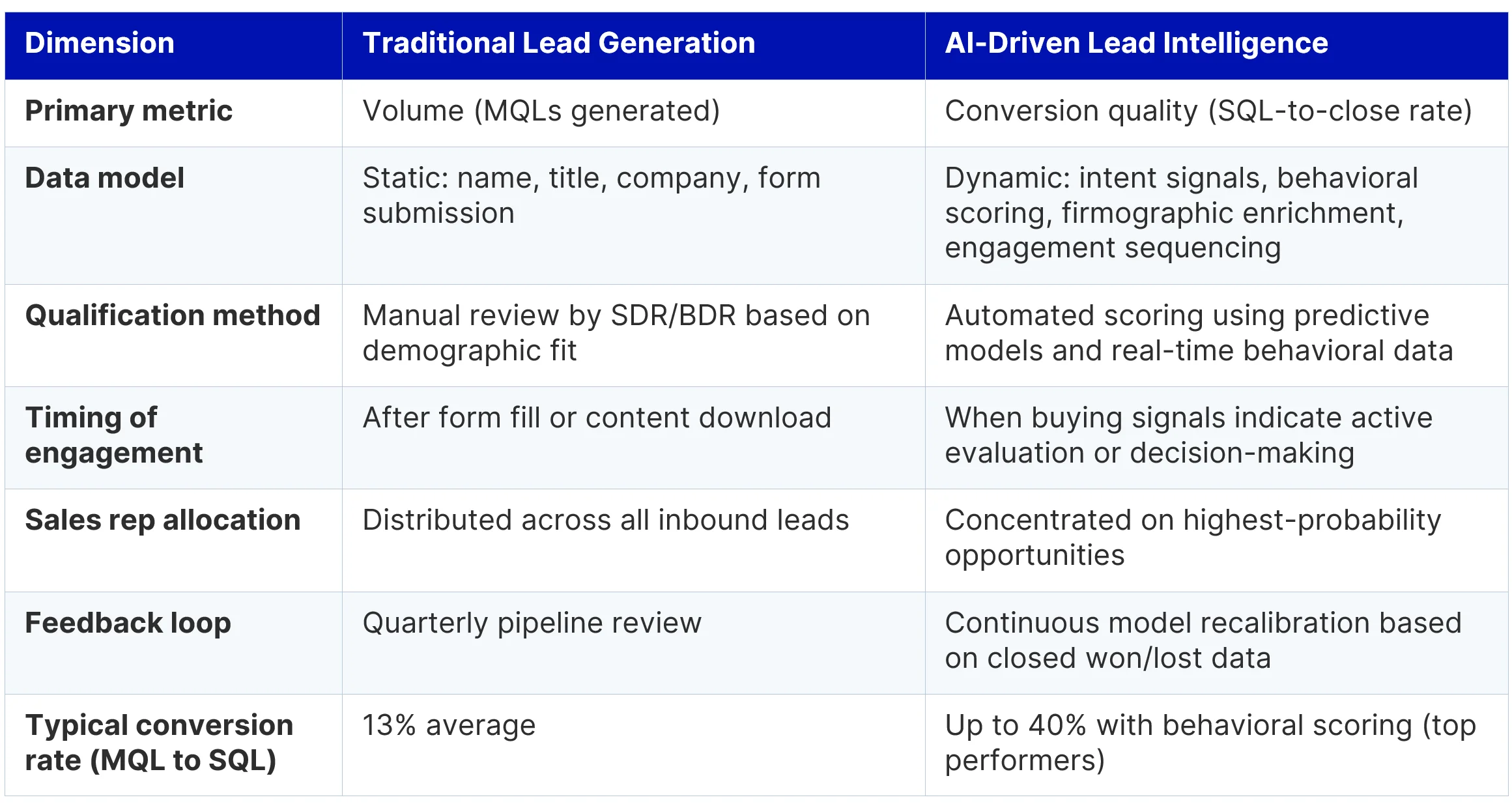
Lead generation asks: How do we get more names into the funnel? Lead intelligence asks: Which of these names are actually going to buy, when, and what do we need to know to engage them effectively? The shift is from volume acquisition to signal interpretation, and it changes every downstream metric.
Lead generation, in its traditional form, is a capture mechanism. It produces contact records: a name, an email, a company, and perhaps a job title. The qualification that follows is often manual, lagging, and based on demographic fit rather than behavioral readiness. The conversion math is straightforward and unflattering: generate a large volume, accept that most will not convert, and hope that the small percentage that does is enough to hit target.
Lead intelligence is an entirely different operating concept. It layers real-time behavioral data, intent signals, firmographic enrichment, and predictive scoring on top of every prospect interaction. Instead of asking whether a lead matches an ideal customer profile on paper, it asks whether that lead is exhibiting buying behavior right now: researching relevant categories, visiting competitor sites, engaging with specific content types, or showing organizational signals like new executive hires or recent funding rounds.
The distinction matters because it changes where human selling time gets allocated. In a volume-based model, representatives spend the majority of their day sifting through undifferentiated leads. In an intelligence-driven model, AI handles the sifting, enrichment, and initial scoring, and representatives engage only when the data indicates a genuine opportunity.
Where Does AI Actually Add Value in the Sales Pipeline?
AI adds the most measurable value in four specific pipeline functions: signal detection, data enrichment, predictive scoring, and intelligent routing. In each case, the value comes not from replacing human judgment but from eliminating the manual work that prevents representatives from exercising it.
1. Signal Detection: Identifying Buying Intent Before First Contact
The highest-performing sales organizations in 2025 and 2026 are using multi-signal intent systems that aggregate data from dozens of sources: content consumption patterns, competitor website visits, job change announcements, funding events, product comparison downloads, and engagement sequencing across channels. According to Gartner, by 2027, over 70% of B2B companies will use predictive intent models, up from less than 30% in 2023. Companies using enriched, signal-augmented CRM data generate 44% more sales-qualified leads than those relying on base contact data alone (Salesforce Research, 2024).
2. Data Enrichment: Turning Partial Records into Complete Profiles
A raw lead record is a name on a list. An enriched lead record includes firmographic data, technographic context, organizational hierarchy, recent news events, and social engagement history. AI-driven enrichment tools can populate these fields in seconds, a process that would take a human representative 15 to 30 minutes per lead. Given that inaccurate data wastes 27.3% of a sales rep’s time (Salesforce), automated enrichment has a direct and measurable impact on selling capacity.
3. Predictive Lead Scoring: Replacing Gut Feel with Pattern Recognition
Traditional lead scoring assigns points based on demographic attributes: job title, company size, industry. Predictive scoring uses machine learning to identify behavioral patterns that actually correlate with closed deals in your specific pipeline. The performance gap is significant. The average MQL-to-SQL conversion rate sits at 13%. Top performers using behavioral scoring achieve conversion rates as high as 40%, more than triple the average. AI-based lead scoring improves conversion rates by up to 51%, according to aggregated B2B benchmarks.
4. Intelligent Routing: Getting the Right Lead to the Right Rep at the Right Time
Speed-to-lead remains one of the strongest predictors of conversion. Research shows that responding within the first five minutes of an inquiry multiplies qualification odds by up to 9x. Yet 44% of sales representatives report being too busy to follow up quickly. AI-powered routing eliminates this bottleneck by automatically matching leads to representatives based on expertise, territory, capacity, and deal characteristics, ensuring that high-intent prospects are engaged immediately rather than sitting in a queue.
What Does the ROI Look Like When Organizations Get This Right?
Organizations that shift from volume-based lead generation to intelligence-driven pipeline management consistently report 15% to 25% higher conversion rates, 30% to 50% shorter sales cycles, and 20% to 40% reductions in sales operations costs. The gains compound because every improvement in lead quality amplifies the productivity of every downstream function.
The math is straightforward. If your current MQL-to-SQL conversion rate is 13% (the industry average) and you move to a behavioral scoring model that achieves 30% conversion, you have more than doubled your qualified pipeline without generating a single additional lead. The downstream effects cascade: fewer wasted outreach hours, shorter sales cycles because representatives are engaging buyers who are further along in their decision process, and more accurate revenue forecasts because the pipeline reflects genuine intent rather than form-fill volume.
Salesforce’s 2026 State of Sales report, based on a survey of more than 4,000 sales professionals, found that 87% of sales organizations now use some form of AI, and 89% of sellers using AI say it deepens customer understanding. High-performing sellers (those who substantially increased year-over-year revenue) are 1.7 times more likely to use AI agents for prospecting than underperformers. At Salesforce’s own sales organization, AI agents contacted 130,000 previously untouched leads in four months and generated 3,200 new opportunities.
McKinsey’s research on AI in B2B sales estimates a 15% to 25% increase in ROI, 30% to 50% reduction in lead conversion time, and 20% to 40% cost savings on sales operations for organizations that deploy AI effectively across the pipeline.
Anonymized Case: Mid-Market Professional Services Firm (180 Employees)
Before intelligence layer deployment:
- SDR team of 8 spent approximately 65% of their time on manual lead research and outreach to unqualified prospects.
- Average MQL-to-SQL conversion rate: 11%.
- Average time from first touch to qualified opportunity: 34 business days.
- Cost per qualified opportunity: approximately $2,800.
After implementing an AI-driven lead intelligence framework:
- AI handles intent monitoring, data enrichment, and initial scoring. SDRs shifted to high-value engagement and relationship development.
- MQL-to-SQL conversion rate: 29% (a 2.6x improvement).
- Average time from first touch to qualified opportunity: 14 business days.
- Cost per qualified opportunity: approximately $1,350.
- Pipeline coverage ratio improved from 2.1x to 3.4x within two quarters.
The firm did not reduce headcount. It reallocated capacity. SDRs who had spent the majority of their time on data work were repositioned into consultative outreach roles, resulting in both higher conversion rates and measurably better client engagement scores.
How Do You Build a Lead Intelligence Operating Model? A Step-by-Step Methodology
Start with a pipeline audit, not a technology evaluation. The most common failure mode is purchasing AI tools before understanding which pipeline problems actually need solving. The methodology below provides a structured path from diagnosis to deployment.
- Step 1: Pipeline Forensics (Weeks 1 to 2). Audit your current pipeline end-to-end. For every stage, document: lead source, time-in-stage, conversion rate, reason for disqualification, and cost. Identify where volume drops off and where cycle time expands. The goal is a quantified baseline, not an opinion about what is working.
- Step 2: Lead Quality Segmentation (Week 3). Segment your last 12 months of closed-won and closed-lost deals by lead source, engagement pattern, firmographic profile, and time-to-close. Identify the behavioral and firmographic attributes that distinguish leads that convert from those that do not. This becomes the training data for your scoring model.
- Step 3: Signal Architecture Design (Weeks 4 to 5). Map the intent signals that are observable and actionable for your specific market. These typically include: content engagement patterns (which topics and formats correlate with buying), competitor research activity, organizational triggers (leadership changes, funding, expansion announcements), and direct engagement signals (pricing page visits, demo requests, return visits). Define which signals should trigger automated actions and which should trigger human engagement.
- Step 4: Technology Evaluation and Selection (Week 6). Evaluate tools against the signal architecture you have designed, not the other way around. Assess AI platforms on four criteria: data source breadth, scoring model transparency, CRM integration depth, and measurable accuracy benchmarks. Any tool that cannot demonstrate above 90% accuracy in a controlled pilot should be eliminated.
- Step 5: Human-AI Handoff Architecture (Week 7). Define precisely where in the pipeline AI operates autonomously and where human judgment takes over. For most organizations, AI should handle signal detection, enrichment, initial scoring, and routing. Humans should handle all direct prospect engagement, complex qualification conversations, and final opportunity validation. The handoff points must be explicit, documented, and measurable.
- Step 6: Pilot Deployment (Weeks 8 to 14). Deploy the intelligence layer on a defined subset of the pipeline, typically one product line, one territory, or one lead source. Measure against your baseline: conversion rate improvement, cycle time reduction, cost per qualified opportunity, and representative satisfaction. Do not scale until pilot metrics meet predefined thresholds.
- Step 7: Governance and Continuous Calibration (Ongoing). AI scoring models degrade over time as market conditions and buyer behaviors shift. Establish a monthly review cadence for model performance, a quarterly recalibration cycle, and clear escalation paths for when the model produces anomalous outputs. The intelligence layer is a living system, not a one-time implementation.
What Are the Hidden Costs and Failure Modes That Derail Lead Intelligence Programs?
The most common causes of failure are not technology limitations. They are data readiness gaps, misaligned incentive structures, and the failure to redesign downstream workflows around the new intelligence. Every one of these is preventable with upfront process design.
- Data readiness: Most enterprise CRM data is not AI-ready. Gartner estimates that data preparation and cleaning consume 60% to 80% of total AI project time. If your CRM is populated with incomplete records, inconsistent field usage, and years of accumulated duplicates, the AI layer will inherit and amplify those problems. Data remediation must precede technology deployment.
- Incentive misalignment: If marketing is measured on MQL volume and sales is measured on closed revenue, introducing a lead intelligence layer that deliberately reduces lead volume (in favor of higher quality) will create organizational friction. The metrics must be realigned before deployment. Pipeline contribution and revenue influence should replace volume targets.
- Workflow inertia: Deploying AI scoring without changing how representatives work produces minimal results. If reps continue to work leads in the order, they arrive rather than in the order the model prioritizes them, the intelligence layer is generating insights nobody acts on. Workflow redesign is not optional; it is the mechanism through which AI value is captured.
- Model opacity: 43% of sales leaders cite AI hallucination as a major risk to customer relationships. If your scoring model cannot explain why, it scored a lead the way it did, representatives will not trust it, and adoption will stall. Require interpretable models that surface the signals behind every score.
- Change management underinvestment: The human cost of reorganizing sales workflows around AI is routinely under budgeted. Resistance, retraining, and productivity dips during transition typically extend ROI timelines by 3 to 6 months. Budget for this explicitly.
Decision Checklist: Is Your Pipeline Ready for a Lead Intelligence Upgrade?
Use this checklist to assess whether your current pipeline architecture supports an intelligence-driven model, and where the priority gaps are.
- Is your MQL-to-SQL conversion rate below 20%? (Yes = strong candidate for intelligence upgrade)
- Do your sales representatives spend more than 50% of their time on non-selling activities? (Yes = immediate ROI opportunity)
- Is your CRM data clean, de-duplicated, and consistently structured? (No = data remediation must come first)
- Can you identify the behavioral patterns that distinguish closed-won from closed-lost in your last 12 months of deals? (No = start with pipeline forensics)
- Are marketing and sales aligned on a shared definition of a qualified lead? (No = alignment must precede technology)
- Do you currently track intent signals beyond form fills (content engagement, competitor research, organizational triggers)? (No = signal architecture is a priority)
- Is your average speed-to-lead response time under 60 minutes for high-intent prospects? (No = routing and automation should be addressed immediately)
- Do you have a defined plan for how freed-up sales capacity will be redeployed? (No = pause until you do)
Frequently Asked Questions (FAQs)
No. It repositions the function. AI handles the data-intensive work that currently consumes the majority of SDR time: research, enrichment, initial qualification, and routing. SDRs shift to higher-value activities: consultative outreach, relationship development, and complex qualification conversations. The Salesforce 2026 State of Sales report found that sellers expect AI agents to reduce prospect research time by 34% and email drafting time by 36%, freeing meaningful capacity for direct engagement.
Well-scoped deployments typically show measurable pipeline improvements within 9 to 14 weeks of pilot launch. Boston Consulting Group’s 2024 research found that 74% of companies struggle to move AI beyond pilot stage, and the primary differentiator is scope discipline. Organizations that deploy against three to five clearly defined pipeline problems see returns fastest, while those attempting broad transformation programs stall in integration complexity.
AI amplifies the quality of whatever data it receives. If your CRM is populated with stale, incomplete, or duplicated records, the intelligence layer will produce unreliable outputs. Data remediation must precede or run parallel to any AI deployment. This typically involves deduplication, field standardization, enrichment of core records, and establishing ongoing hygiene protocols. Most organizations underestimate this step, which is why Gartner reports that data preparation consumes 60% to 80% of total AI project time.
No. Mid-market organizations often see the fastest and most pronounced returns because they have enough pipeline volume to benefit from AI scoring but are still small enough that manual qualification creates a genuine bottleneck. The methodology scales to any organization with a repeatable B2B sales process, a CRM with historical deal data, and a willingness to redesign workflows around intelligence rather than volume.
Track four metrics against your pre-deployment baseline: MQL-to-SQL conversion rate, average cycle time from first touch to qualified opportunity, cost per qualified opportunity, and pipeline coverage ratio. If the intelligence layer is working, conversion rate goes up, cycle time goes down, cost per opportunity decreases, and pipeline coverage improves. Review these monthly and recalibrate the scoring model quarterly.
How Cordatus Resource Group Can Help
The shift from lead generation to lead intelligence is not a technology purchase. It is an operating model redesign that touches pipeline architecture, data infrastructure, sales workflows, marketing alignment, and performance measurement simultaneously. Getting any one of these wrong stalls the entire program.
Cordatus Resource Group works with mid-market and enterprise organizations to design, implement, and govern lead intelligence frameworks that are grounded in process reality, not vendor promises. Our approach follows the methodology outlined in this insight: pipeline forensics first, signal architecture second, technology selection third, and human-AI handoff design always.
We bring deep operational experience across financial services, professional services, healthcare, and technology sectors, helping clients move from bloated, low-conversion pipelines to precision-driven sales engines that deliver measurable improvements in conversion rates, cycle times, and acquisition costs.
Whether you are evaluating your first AI investment in sales operations, restructuring an underperforming pipeline, or building the governance layer for an intelligence program already in flight, Cordatus Resource Group provides strategic clarity and hands-on execution support to get it right.


