HR systems that run on a defined process anyone can follow

Hiring through offboarding, documented and auditable at every step.

The Full Lifecycle

What sits inside this practice

The full employee lifecycle, from the requisition opening to the exit interview closing.

Candidate Sourcing and Screening

Onboarding and Employee Integration

Payroll Administration

Benefits Enrollment and Administration

Employee Records Management

HR Compliance Documentation

Performance Management Systems and Support

Training and Development Coordination

Employee Relations Support

Offboarding and Exit Processing

  The Recurring Gaps

Where HR functions typically get stuck

01

The process lives in one person’s head

Onboarding works because someone remembers the sequence. When that person is out, or leaves the organization, the process falls apart. New hire onboarding slows down, paperwork gets missed, and nobody knows exactly how to get things back to normal.

02

Hiring capacity moves in the wrong direction

Hiring needs spike during a growth phase or right after an acquisition; exactly when the HR team has the least room for error or delays. Roles sit open, the pipeline thins, and screening quality drops under volume.

03

Compliance holds until someone checks

Employee files are complete in most places. The gaps surface during an audit, a claim, or a diligence request, and closing them becomes an exercise in reconstruction across systems, inboxes, and folders.

   How Capabilities Apply

How every capability applies to people operations

Clients engage one or more of these at their discretion. Sometimes a process redesign is the whole engagement. In others, automating one high-volume part of the cycle is all that is needed. Where a people operations team is deployed, it runs under an ISO 9001 certified quality framework with supervision and quality assurance at every stage.

One capability or all of them. Whichever way an engagement starts, the same standards govern the work.

Running Modern HR

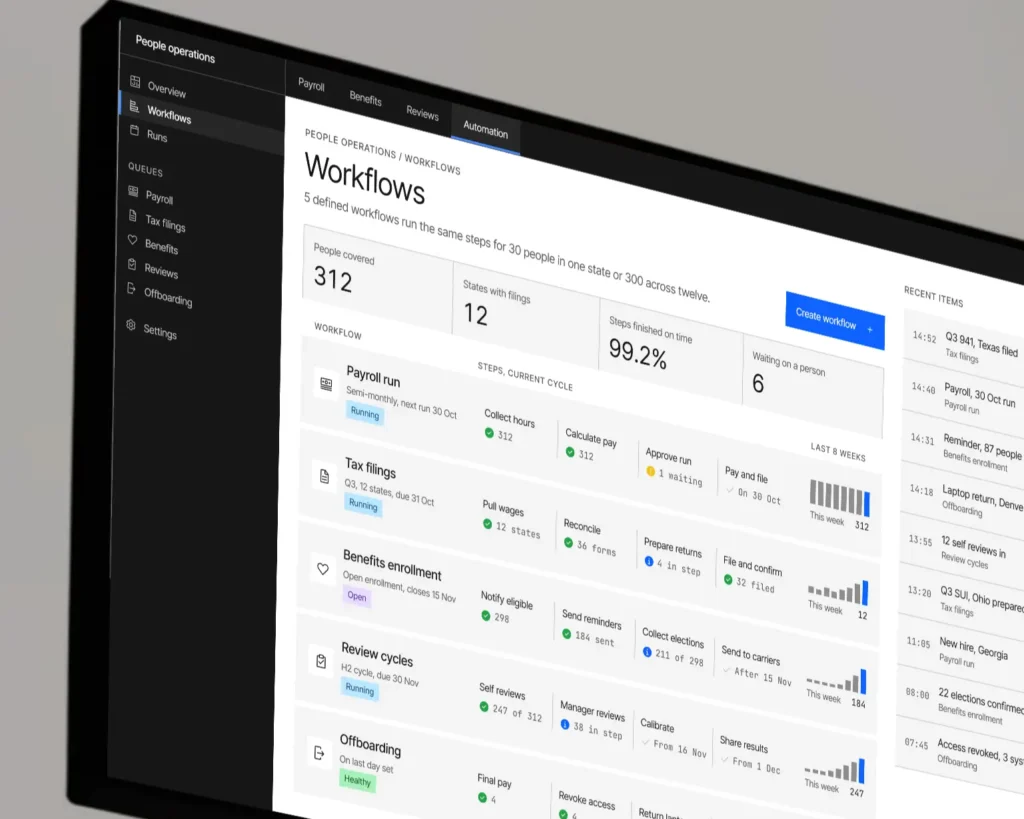
The systems running modern people operations

Platform-agnostic. Solutions are designed around your current stack. When new platforms are in scope, the same team can advise on changes to improve throughput and accuracy.

Disclaimer: All product names, logos, and brands are property of their respective owners. Use of these names, logos, and brands does not imply endorsement.

   Frequently Asked Questions

Questions HR leaders ask

Does an engagement require outsourcing our HR function?

No. Clients engage Cordatus for one or more of the capabilities outlined above at their discretion. Sometimes a process redesign or automation buildout is all that is required. When clients need to augment their team with experienced HR professionals, managed services can be applied.

They become the best source of information on how the function actually runs. They know where the exceptions and the inefficiencies sit, and they help identify and quantify them. As efficiency improves, that team spends less of its week on repetitive, low-value work and more of it on work that calls for their experience and judgment.

Every engagement is supervised by senior HR professionals who are accountable for the outcome. The people handling day to day execution are trained on the documented process and work inside an ISO 9001 certified quality framework. Where a client’s situation calls for a specific credential, certified HR practitioners are brought onto the engagement.

No. Cordatus does not place candidates on a contingency or retained basis. Candidate sourcing and screening sit inside this practice because hiring is one stage of the employee lifecycle this team operates, alongside onboarding, records, payroll, and offboarding. The engagement is running the function, and hiring is one part of it.

No. Employees remain employed by the client under the client’s existing structure. Cordatus operates the people function on the client’s behalf and does not enter into a co-employment arrangement or take on employer of record obligations.

No. Cordatus does not require any changes to client tech stacks. There are no reseller agreements and no preferred platforms. Where a migration is genuinely the right move, that case gets made with numbers behind it.

Cordatus runs inside an ISO 27001 certified information security environment, with access controls and data handling protocols mapped to GDPR and HIPAA requirements where the sector demands it.

Yes. Typically right after an acquisition or inside a value creation window, and frequently involving consolidation of people operations across newly combined entities with different systems and policies.

With an assessment. It maps the current hiring and onboarding cycle, the systems, and records, and produces a baseline and sequenced plan before anything changes.

Start with an assessment

A consultation looks at how the people function actually runs today and where the risk sits. It produces a read on what is worth changing first.